Update of 28 November 2026: Until 27 November the answers came from our own language model on the DF6AX AI server, as described in this article. That server now runs a different model that is not suitable for a public chat. The answers are therefore now written by OpenAI's GPT-5.4 mini. The knowledge base, repeater search and web search still run on the df6ax.de server. The sections on hardware, model and Strata describe the previous set-up. What this means for privacy is explained below and in the privacy policy.
Which repeater is near me? What is the difference between DMR+ and BrandMeister? How do I install FMNetWeb on a Raspberry Pi? For questions like these, df6ax.de has the radio assistant (its German name is “Funk-Assistent”). It knows the pages and manuals of this website, searches the repeater list and helps with questions about radio, AI and code.
Originally the answers came from an AI run right here, a language model with 125 billion parameters on a single graphics card. Today OpenAI's GPT-5.4 mini writes the answers, while the df6ax.de server looks up the matching content itself. For current information, the assistant searches the web via our own search engine when needed.
Why our own AI?
Many chatbots on the web send every question to a large cloud provider. That is convenient but has consequences: the texts leave your own sphere of control, often the EU as well, and every answer costs money per request. For an amateur radio site, that does not fit well with the home-brew spirit.
That is why the radio assistant ran on our own hardware until November 2026. This had three advantages:
- Privacy: questions and answers stayed on our own network and did not go to any AI provider. Only for a web search did a short search term leave the network.
- Independence: no account with a provider, no changed terms of use, no models switched off overnight.
- Cost: instead of fees per request there was only the electricity bill. The server is running for other AI projects anyway.
The price: even a large model on your own hardware has to be heavily compressed and is smaller than the biggest cloud models. It knows a lot, but it can get details wrong now and then. More on that below.
How the radio assistant is built
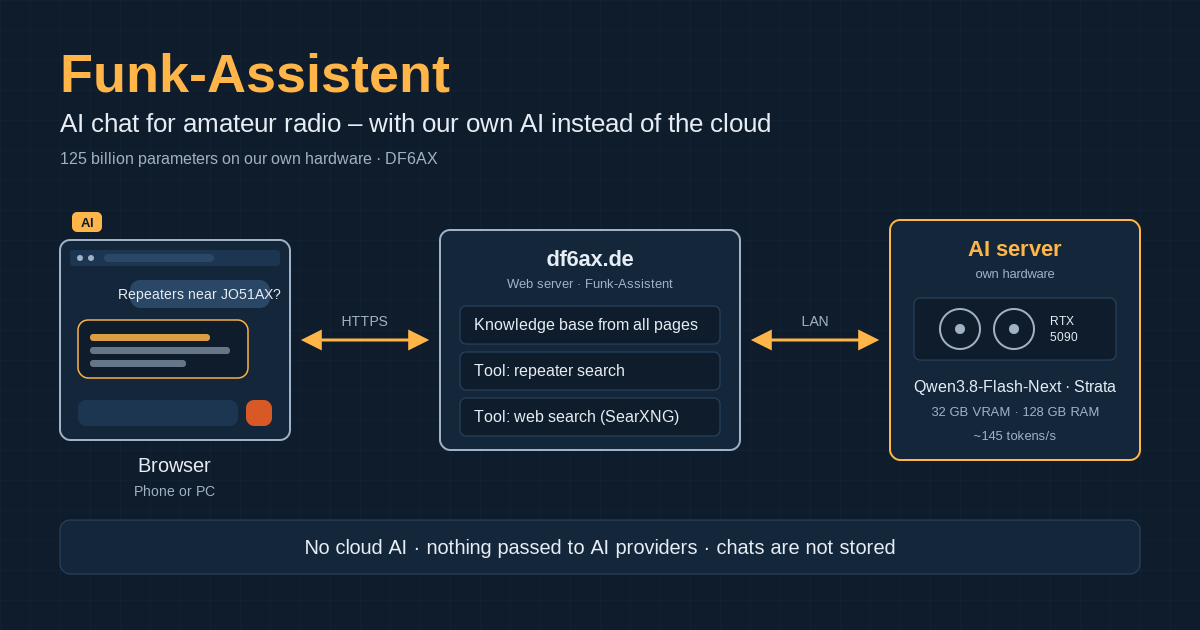
The set-up has three parts. The chat window runs in the browser. It sends your question encrypted to the df6ax.de web server. There, a small service prepares the question: it adds the rules for the bot and the knowledge base and passes everything to the language model: today to GPT-5.4 mini at OpenAI, until November 2026 over the local network to our own AI server. The answer comes back word by word and appears in the chat straight away, while the rest is still being written.
The web server does not pass on your IP address or browser data. The language model only sees the text of the conversation and the matching excerpts from the knowledge base.
The hardware (until November 2026)
The AI server is a PC on the network that provides language models for several projects:
- Graphics card: NVIDIA GeForce RTX 5090 with 32 GB of video memory
- Processor: AMD Ryzen 9 9950X with 16 cores and 32 threads
- RAM: 128 GB
- Operating system: Debian 13
The graphics card and RAM share the work; more on that in a moment. An answer is generated at about 145 tokens per second, roughly 100 words. Short answers are usually done within a few seconds. If the assistant needs the repeater search or the web search, it takes a little longer.
The previous language model: Qwen3.8-Flash-Next
The model was Qwen3.8-Flash-Next, a freely available open-weight model with around 125 billion parameters. “Open weight” means the fully trained weights are published and may be run on your own hardware. Normally a model of this size needs a server with several professional graphics cards.
The model works on the mixture-of-experts principle. It consists of many specialised sub-networks, the “experts”, and only a few of them are active for each word. So only a small part of the 125 billion parameters is ever used in a calculation. That is exactly what makes it possible to run the model on a single PC.
To fit into memory, the model is quantised at size IQ3_S: the numbers in the network are stored with just over three bits instead of 16. That costs a little accuracy and saves a great deal of memory. The model can process very long texts in one go, up to 262,000 tokens. That mattered, because at first it read the entire knowledge base with every question.
Strata: a large model on one graphics card
Even compressed, the model is almost 80 GB, but the graphics card only has 32 GB. This is where Strata comes in, a free inference server (MIT licence) built for exactly this purpose: running large mixture-of-experts models on ordinary PCs with one graphics card.
- Experts in RAM: the parts needed for every word sit on the graphics card. The many experts live in the PC’s RAM, which is what the 128 GB are for.
- Expert cache: Strata also keeps frequently used experts on the graphics card. For the radio assistant, the log shows this cache hitting in around 98 % of cases; only the rest has to be loaded over the PCIe bus.
- Guessing ahead: a small add-on part of the model proposes the next words, and the large model checks several of them in one step. That speeds up the answer without changing it.
- Economical context: Strata stores the cache for long texts with 8 bits instead of 16. That way the roughly 50,000 tokens of knowledge base still fit into memory with every question.
Strata provides an OpenAI-compatible interface. So the radio assistant talked to it just as other programs would talk to a cloud service, only on our own network. Strata runs there as a Docker container alongside other AI services.
What the assistant knows
The model brings its general knowledge of amateur radio, electronics and programming from its training. It knows about df6ax.de because the service builds a knowledge base from the pages: the project articles, the station, the repeater overview and the PDF manuals, now around 300,000 characters in total. For each question the service picks out the matching sections and only sends those. When a page changes, the knowledge base is rebuilt within five minutes. So the assistant knows about new articles almost immediately, including this one.
For repeaters, the assistant has a tool. If you ask about repeaters in a town, within a radius, on a band or in a network, it searches the df6ax.de repeater list itself. This list contains analogue FM repeaters as well as DMR BrandMeister, DMR+, FM-Funknetz, D-Star, EchoLink and C4FM. The model decides when it needs the tool and builds the answer from the result.
The second tool is a web search. It runs via our own search engine, a SearXNG instance on the web server. SearXNG queries several search services at once and combines the results. The assistant only uses the web search when the knowledge base and the repeater search are not enough, for example for dates, current software versions or data sheets. It gives the sources as links so you can read them yourself.
What you can ask
“Which 70 cm repeaters are there within 25 km of Hildesheim?” or “Which DMR repeater near JO51AX has TG 262 static?” The assistant searches the repeater list and gives frequencies, shift, CTCSS or colour code. The map is under Repeaters.
“How do I install FMNetWeb?”, “What can the DV-Box 3 do?” or “Which radios does Icom Web-Remote support?” The answers are based on the articles and manuals on this site and link to the right place.
“How does QO-100 work?”, “What does QRV mean?” or “Which antenna is suitable for 2 m in the loft?” For general radio questions, the assistant uses its training knowledge.
“How do I parse a Maidenhead locator in Python?” or “How do I control an ESP32 via MQTT?” For programming questions, the assistant explains the approach and shows short example code.
“When is the next HAM RADIO in Friedrichshafen?” or “What is the current version of SvxLink?” Here the assistant searches the web via SearXNG and gives the sources as links.
Privacy
Before the chat starts, a notice explains what happens to your input. Nothing is transmitted until you agree. The web server does not store any conversation content. It sends your question, the conversation history and matching excerpts from the knowledge base to OpenAI so that GPT-5.4 mini can write the answer, but not your IP address or browser data. OpenAI does not use requests made through its API for training, but keeps them for up to 30 days to detect abuse. Data may also be processed in the USA. For statistics, the web server only counts requests, response times and errors per day and hour. The conversation history stays only in your browser tab and disappears when you close it.
For a web search, a short search term that the model derives from your question goes via SearXNG to external search services such as Google or DuckDuckGo. The request comes from the df6ax.de server, not from your browser: your IP address and the rest of the conversation are not transmitted. The assistant is instructed not to include any personal details in search terms.
Still: please do not enter names, addresses, phone numbers or login details in the chat. The details are in the privacy policy.
Limits
The radio assistant is an AI, not Frank. It can be wrong, especially with numbers, frequencies and regulations. So check important information yourself, for example on the repeater map, in the manuals or with the Bundesnetzagentur (the German regulator) and the DARC. The repeater data comes from the respective networks and is only as accurate as the entries there.
The assistant sticks to its topics: amateur radio, AI and programming and the projects on df6ax.de. It politely declines other questions. It does not know who is currently active on the repeaters; that is what the live dashboards are for. To keep the server from being overloaded, requests are limited.
Frequently asked questions
Are my questions sent to a cloud provider?
Yes, since 27 November 2026: the answers are written by OpenAI's GPT-5.4 mini. For this the web server passes on the text of the conversation and matching excerpts from the knowledge base, but not your IP address. So please do not enter any personal data in the chat.
Does the assistant search the web?
Only when necessary. If the knowledge base and repeater list are not enough, it searches via our own SearXNG instance. Only a short search term goes to search services, without your IP address. It gives the sources as links.
Are my questions stored or used for training?
The df6ax.de web server does not store any conversation content. OpenAI does not use requests made through its API for training, but keeps them for up to 30 days to detect abuse. On df6ax.de only requests, response times and errors are counted.
Why is the answer sometimes wrong?
Language models generate text based on probability and can make mistakes, even when the answer sounds convincing. Please check important information yourself.
Why do I get the message “Zu viele Anfragen” (too many requests)?
So that individual visitors cannot tie up the server permanently, the number of requests per visitor within a short time is limited. After a few minutes you can carry on.
Can I build something like this myself?
Yes. To start with, a PC with a current graphics card and software such as Ollama or llama.cpp, which provides an OpenAI-compatible interface, is enough. For a large model like Qwen3.8-Flash-Next there is Strata, which according to the project works from 12 GB of video memory and 32 GB of RAM. The radio assistant itself is a small Python service that needs no additional libraries. The assistant can also help you with questions about it.
What it all comes down to
The radio assistant has shown that a useful AI chat can work without a cloud provider: one graphics card, plenty of RAM, Strata and an open-weight model with 125 billion parameters were enough to answer questions about repeaters, projects and radio technology within a few seconds, without the conversations ever leaving our own network. Since the AI server now runs a different model, OpenAI's GPT-5.4 mini writes the answers. The knowledge base, repeater search and web search have stayed the same.